Home/Buses in Costa Rica

Buses in Costa Rica: the complete guide
Find Your Bus Route

Pick your origin to see the destinations you can reach by bus, with a link to the detailed route guide.

Buses in Costa Rica: the complete guide

Taking the bus in Costa Rica is the most affordable and one of the most authentic ways to explore the country. Whether you are backpacking, traveling solo, or just traveling on a budget, the buses connect almost every destination, from remote beach towns to lush mountain villages.

This is the system locals use every day, and there is no reason you cannot use it too. Below you will find how it works, which terminal serves which region, what tickets cost, and the tips that will save you time and colones. If you decide the bus is too slow for a particular leg, our Costa Rica transportation guide covers the alternatives.

How the bus system works

Costa Rica has no national bus company and no single central station. Instead, private companies each run their own routes from their own terminals, and downtown San José acts as the country's de facto hub, with scheduled departures fanning out across the country from there.

The essentials

  • Coverage: you can reach almost any part of the country by bus, including national parks, small towns, and popular beaches. The notable exception is the North Caribbean coast, where swampy terrain makes roads impractical
  • Companies: the system is operated by private companies such as Tracopa, TUASA, MEPE, Carbachez, and Empresa Alfaro, each with its own terminals and ticket offices
  • Cost: local trips start around ₡600 (about $1 USD) and long-distance routes rarely exceed $10–$13
  • Frequency: most routes run multiple times per day, with the most departures out of San José
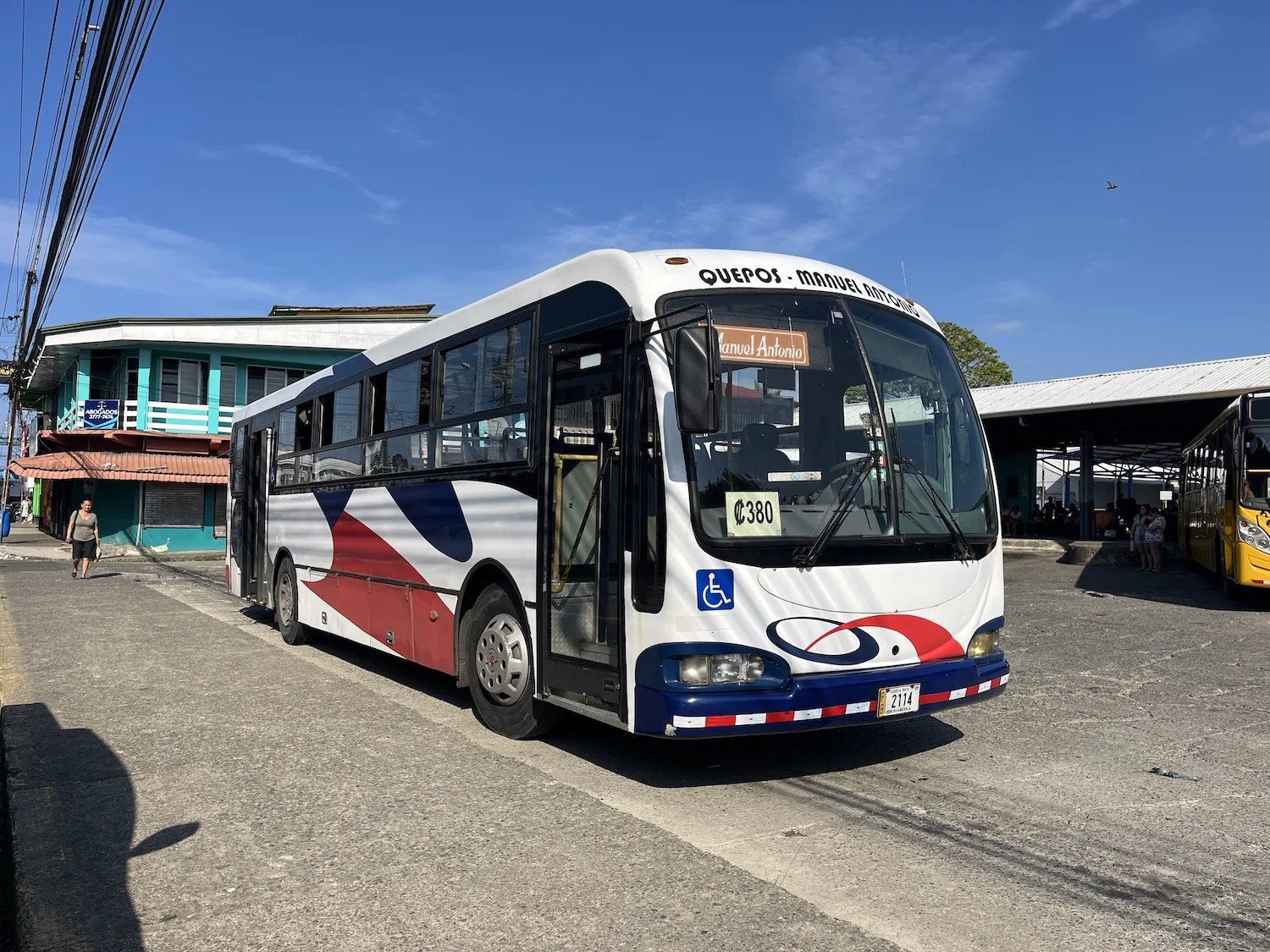
  • Comfort: expect a mix. Companies on the major routes run modern, spacious, often air-conditioned coaches, some with Wi-Fi, while rural routes are frequently old US school buses with open windows
  • You can read more about the operators, their terminals, and their quirks in our article on the four main bus companies in Costa Rica. Each runs its own schedules, ticket rules, and luggage policies, so a rule that applies on one route may not apply on the next.
  • Buying tickets

    Ticket buying varies by company, which trips up travelers used to one national system:

  • Most companies sell tickets at the terminal window on the day of travel, cash only on many routes
  • Tracopa also sells tickets online through its website and an app with seat selection, and you can buy up to a month in advance
  • Grupo Blanco sells tickets at the window up to 3 days ahead and online up to 15 days ahead, with a small online service charge of ₡350
  • MEPE is the exception on payment: cash only, no cards and no online system, and its phone line is famously busy, so call well in advance if you want to reserve
  • For popular routes and holiday weekends, buy a day or more ahead and arrive at the terminal 30–50 minutes early
  • Buses of the main Costa Rica bus companies
    Buses of the main Costa Rica bus companies

    Main bus terminals in San José

    Because each company runs from its own terminal, knowing where to go is half the battle in San José. Here is which terminal serves which region:

    TerminalRegion ServedCommon Destinations
    Cóbano TerminalNicoya PeninsulaSanta Teresa, Montezuma (via Puntarenas ferry)
    TUASA Terminal (Alajuela)Central Valley / AirportSan Ramón, Grecia, Naranjo, SJO Airport
    Empresa AlfaroNorth PacificNicoya, Tamarindo, Nosara
    MEPE TerminalCaribbean CoastCahuita, Puerto Viejo, Limón
    Carbachez TerminalNorthern HighlandsMonteverde, Santa Elena, Tilarán
    Tracopa TerminalSouthern ZoneManuel Antonio, Uvita, Dominical, Ojochal, Osa
    A bus station in Costa Rica
    A bus station in Costa Rica

    Types of bus routes

    Four kinds of routes cover the country, and knowing the difference helps you pick the right bus.

    Local, direct, regional, and cross-country

  • Local buses: frequent, cheap, and stop often. Ideal for short distances between neighboring towns
  • Direct / express buses (directo): fewer stops and usually more comfortable, perfect for long routes like San José to Manuel Antonio or Puerto Viejo. When a directo exists, take it
  • Regional buses: connect small towns within one province, like Guanacaste or Alajuela
  • Cross-country buses: run between major destinations, often with scheduled 15–30 minute rest stops and a luggage compartment under the bus
  • On many routes you will also see both directo and normal services. The normal bus stops everywhere and can add hours; always ask which one you are boarding.

    What buses cost in Costa Rica

    This is the part backpackers love. Public buses are the cheapest way to travel in Costa Rica by a wide margin.

    Ticket prices

  • Short local routes: $1–$5 per person (some in-town rides start around ₡600, about $1)
  • Long-distance routes: $6–$15 per person
  • Most cross-country trips land around $10
  • Excess luggage (more than two carry-on bags, or big items like surfboards and bicycles): roughly ₡1,000–₡2,000 depending on the company
  • Some companies charge less for children: on Grupo Blanco buses, kids under three ride free entirely
  • Compare that with shared shuttles at $40–$90 per person and you can see why budget travelers build whole trips around the bus network. For the full comparison, see our transportation guide.

    Local tips for taking the bus

    A few habits will make your bus days dramatically smoother. These come from years of riding the routes ourselves.

    Tips from experience

  • Arrive early. Long-distance buses can sell out, especially on weekends and holidays
  • Bring cash in colones. Many routes and terminals do not accept cards
  • Keep your ticket. You will need it to claim luggage from the storage compartment
  • Use Google Maps or Moovit. Both list many Costa Rican bus routes and times
  • Secure your belongings. Stations and crowded buses attract pickpockets; keep valuables on your lap or in a front bag, and never leave anything unattended
  • Pack light. Managing big suitcases through crowded terminals is the worst part of bus travel here
  • Plan for delays. Traffic, rain, and road work can slow things down; patience is part of the Pura Vida experience
  • Check return tickets at arrival. Some small towns, Manuel Antonio among them, may not sell outbound tickets, so buy your return where you can
  • Travel with a schedule screenshot. Some rural stops have no posted timetable, and drivers are happy to point you right if you ask
  • Ask directo or normal. On routes with both services, the direct bus can save hours over the one that stops in every town
  • Mind the last departure. Most long-distance routes finish running by early evening, so a missed morning bus rarely leaves a same-day second chance
  • When to choose the bus (and when not to)

    We are bus fans here, but the bus is not always the best tool for the job. Here is the honest breakdown.

    Take the bus when...

  • A direct route exists between your start and destination. Buses travel just as fast as shuttles, and a directo with few stops matches or beats a shared shuttle for a fraction of the price
  • You are on a budget or traveling slowly. Saving $50+ per leg adds up over a multi-week trip
  • You are not in a rush and want to travel like a local, meeting Ticos and seeing everyday life
  • You care about your footprint: the bus is the most eco-friendly way to move around the country
  • The route reaches places shuttles skip. Rural bus networks go where tourist transport never does
  • Skip the bus when...

  • There is no direct route. Many journeys require three or four bus or ferry changes, early starts, and most of a day; a shared shuttle is worth the money on those legs
  • You have a tight schedule. Buses are the slowest option, and a trip that takes 3.5 hours by car can take 5–6 by bus
  • You are traveling with lots of luggage or surfboards. Overhead space is limited and excess bag fees add up
  • You have an early flight or late arrival. Many routes simply do not run at the hours you need; a private shuttle will pick you up any time
  • If you are weighing all your options, our complete transportation guide compares buses with shuttles, rental cars, and domestic flights.

    Find your bus route

    Use the route finder at the top of this page to search connections between more than 130 destinations in Costa Rica. Pick your origin and destination, and you will see the company, terminal, and typical journey for that route.

    Once you know your route, you can buy your ticket at the terminal or from the company's own site, and check our transportation guide if you want a faster option for any leg.

    Frequently Asked Questions

    Yes, buses are safe and widely used by locals and travelers alike. The main caution is petty theft in crowded terminals and onboard: keep valuables with you, never leave bags unattended, and keep your ticket handy for luggage claims.

    Family-run, based in Manuel Antonio. Real people, quick WhatsApp replies, no hidden fees.

    Same local team. New look.

    Welcome to our
    new website!

    We’ve refreshed our website and updated our booking system to help you plan your Costa Rica trip.

    Having trouble booking or noticing something that isn’t working? Message us on WhatsApp — our team is here to help.

    Chat with us on WhatsApp

    Thanks for your patience. Pura vida!Esteban, Aurélise & Zach